
Bidding on Competitor Keywords in Google Ads (2026): Rules, Brand Bidding, Detection & Defense
The complete 2026 guide to bidding on competitor keywords in Google Ads — what's legal, what triggers a trademark complaint, what it costs, how to detect competitors brand bidding on you with Auction Insights and the Transparency Center, and how to defend your brand.
By the AdMapix Research Team — Updated June 21, 2026
Bidding on Competitor Keywords in Google Ads (2026): Rules, Brand Bidding, Detection & Defense
This guide is for informational purposes only and does not constitute legal advice. Consult a licensed attorney for your jurisdiction before launching a campaign that targets competitor trademarks.
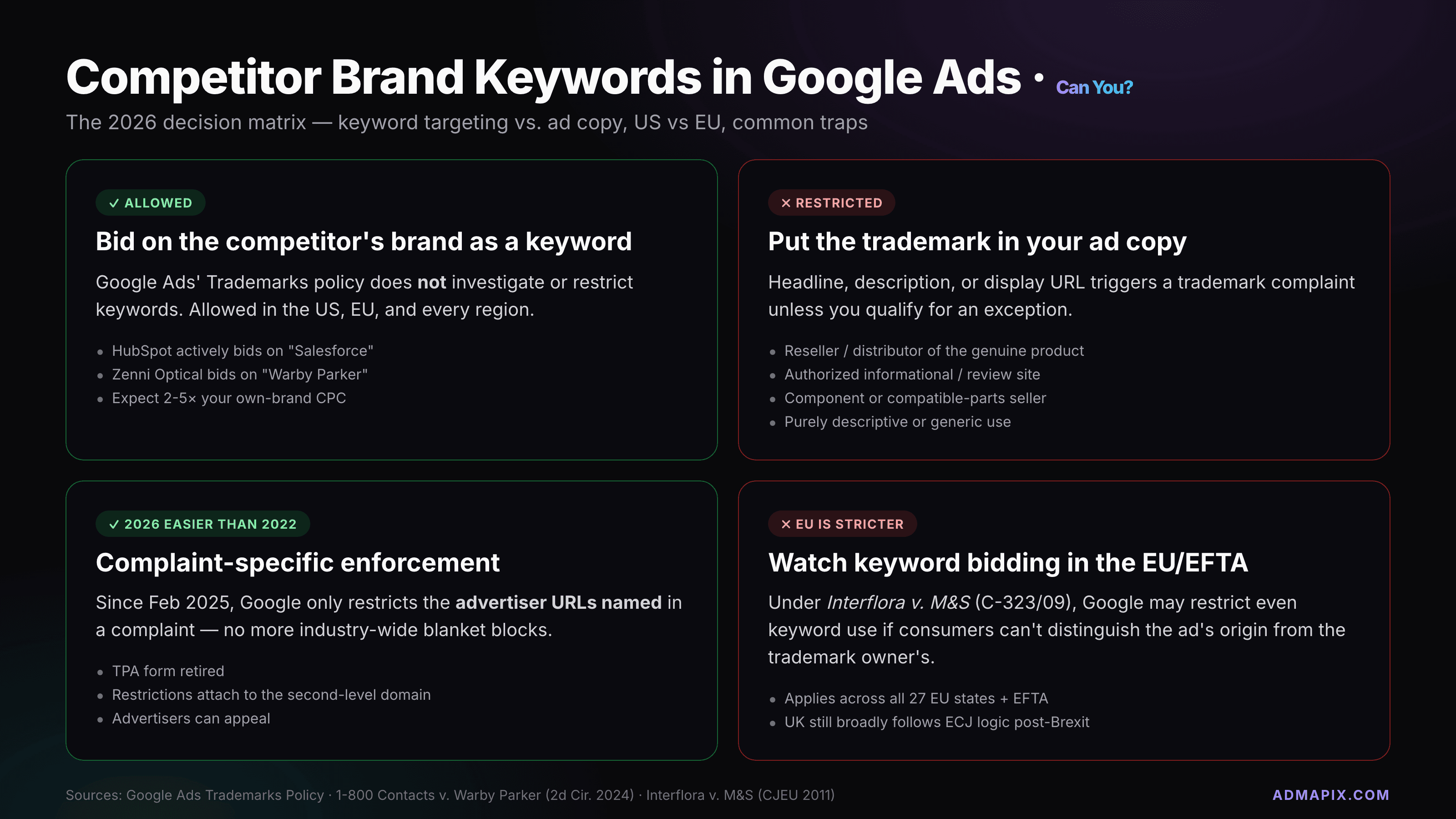
Yes, bidding on competitor keywords — including a rival's brand name — is legal in the United States under Google Ads' current trademark policy, and courts have generally sided with advertisers who target rivals' trademarks as keywords. What you cannot do is drop the competitor's trademarked name into your ad copy, headline, or display URL — unless you qualify for one of four narrow exceptions. This is the complete 2026 playbook: the legal rules, what it actually costs, how to build a compliant attack campaign, how to detect when competitors are brand bidding on you (using Auction Insights and the Transparency Center), and how to defend your brand and intruder impression share. It covers both sides of the auction — playing offense on competitor keywords and playing defense on your own.
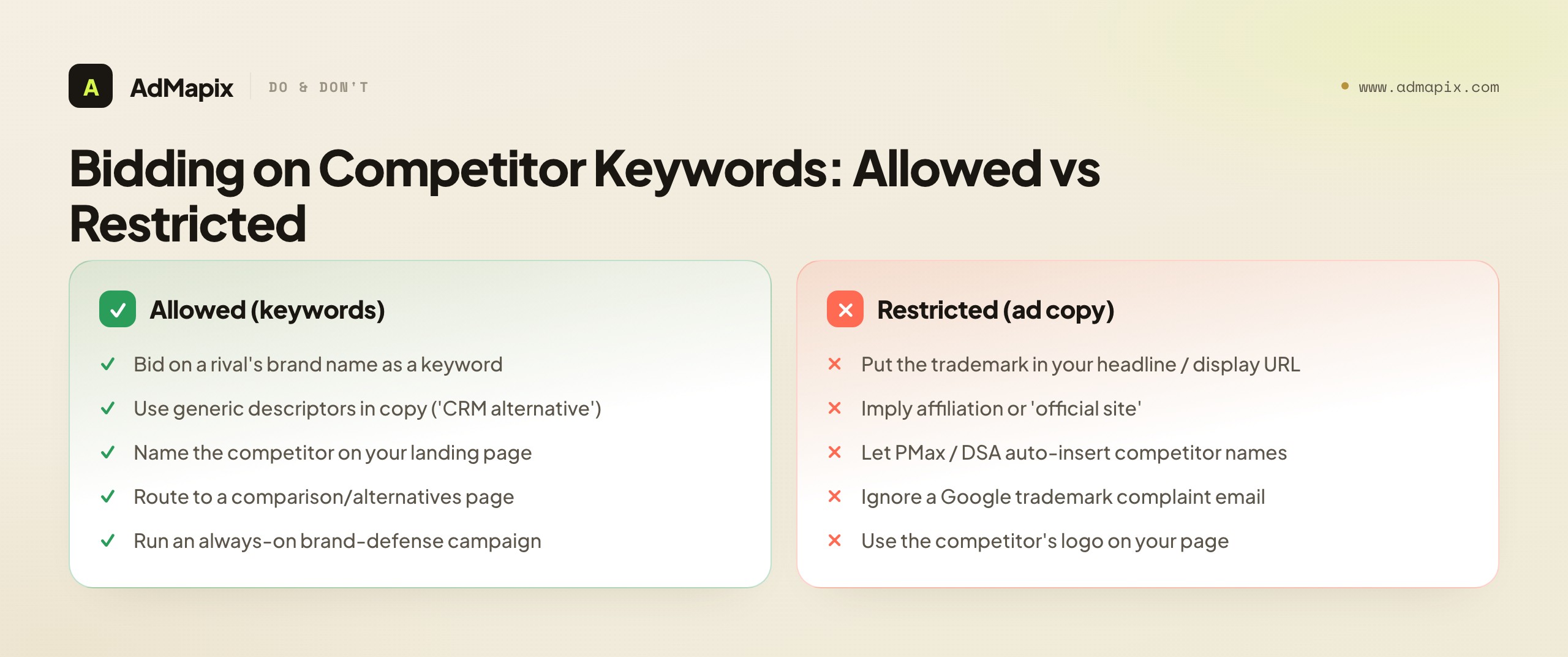
The single most important distinction in this entire topic, stated up front: keywords are unrestricted; ad copy is complaint-driven. You can load any competitor's name into your keyword list right now and nothing at Google will stop you. The friction only appears when a trademark shows up in your ad text and the rights holder files a complaint. Internalize that one line and 80% of the confusion around brand bidding disappears.
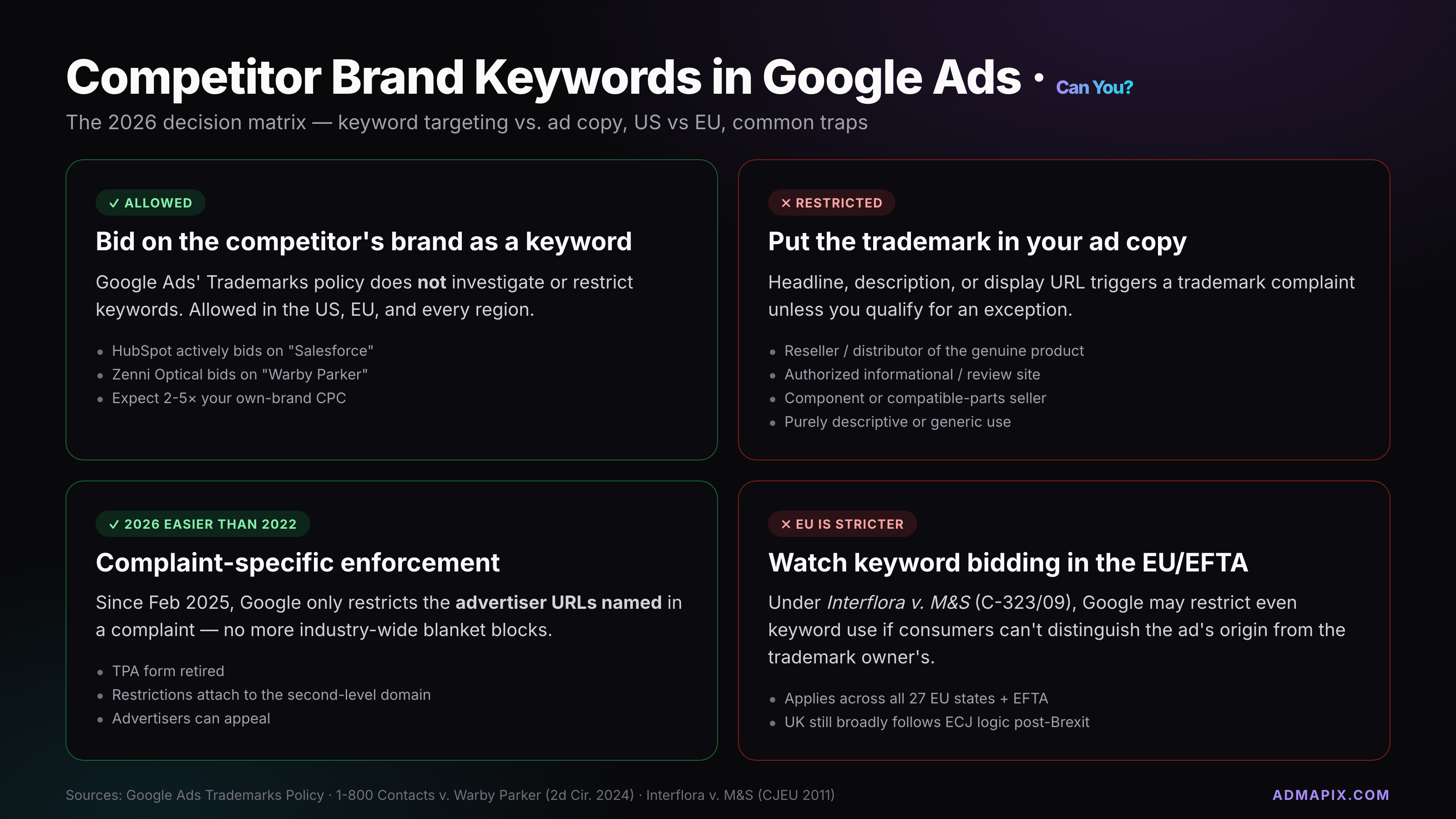
TL;DR — Bidding on Competitor Keywords in One Screen
- It's legal to bid on competitor keywords (including brand names) as keyword triggers in the US — the consumer sees your ad, not your keyword list.
- You can't put a competitor's trademark in your ad copy, headline, or display URL unless you qualify for one of four narrow exceptions (reseller, components/compatible, informational, descriptive).
- It costs more — expect roughly 2×–5× your own-brand CPC because Quality Score craters when your copy and landing page can't mention the brand searched for.
- Route traffic to a real comparison/alternatives landing page (the page can name the competitor — the copy rule applies to ads, not websites).
- Detect competitors brand bidding on you with manual SERP checks, Auction Insights (overlap + impression share), the search terms report, and the Google Ads Transparency Center.
- Defend your brand with an always-on exact-match brand campaign (near-perfect Quality Score, cents-CPC), tight negatives, and intruder impression share monitoring.
- Enforcement is complaint-driven and now advertiser-specific (since Feb 2025) — a complaint that names a rival doesn't touch you.
- International is stricter — the EU/UK Interflora test can find infringement on keyword use alone if your ad leaves users confused about who's advertising.
Do This, Not That — The 60-Second Cheat Sheet
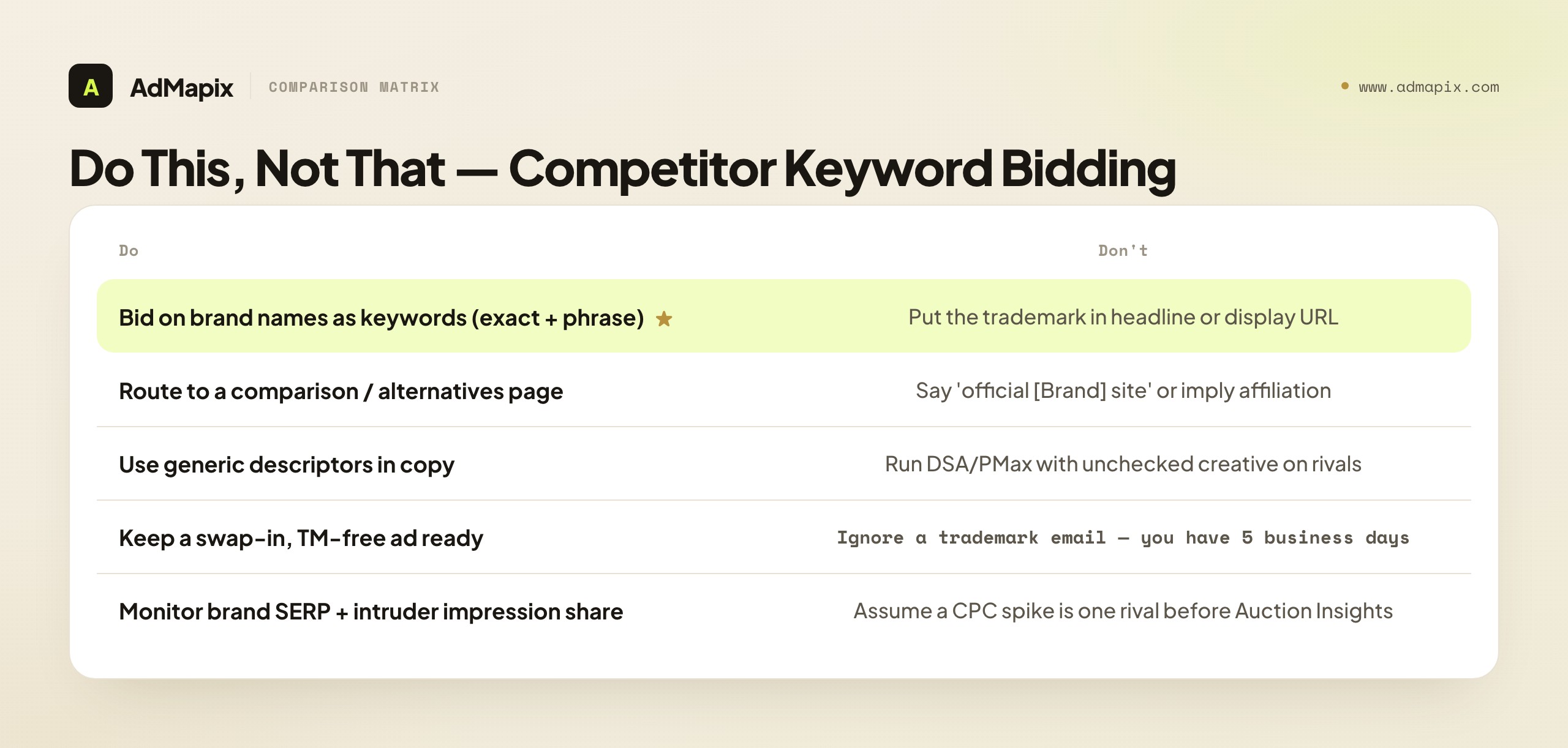
| Do | Don't |
|---|---|
| Bid on competitor brand names as keywords (exact + phrase match) | Put "Salesforce" or any unlicensed trademark in your headline or display URL |
| Route traffic to a comparison or alternatives landing page | Say "official [Brand] site" or imply affiliation |
| Use generic descriptors ("CRM alternative", "project management tool") in copy | Run DSA or Performance Max with unchecked creative on competitor queries |
| Keep a swap-in, TM-free ad variant ready for complaint days | Ignore a Google trademark policy email — you have 5 business days |
| File a Google trademark complaint if rivals copy your brand into their copy | Forget international — EU and UK courts apply a stricter "likelihood of confusion" test |
| Monitor your own brand SERP and intruder impression share weekly | Assume a CPC spike is one competitor before you check Auction Insights |
If you only have sixty seconds, that table is the whole post. The rest explains why each row works, what it costs, how to detect rivals bidding on you, and where the rules differ across jurisdictions.
Is it legal to bid on a competitor's brand as a keyword?
In the US, yes. The Lanham Act — the federal trademark statute codified at 15 U.S.C. §1051 et seq. — requires a plaintiff to prove "likelihood of confusion" in commerce. US federal courts have consistently held that merely selecting a trademark as an invisible keyword trigger does not, by itself, confuse consumers. The consumer sees the ad, not the keyword list.
The leading modern authority is 1-800 Contacts v. Warby Parker, affirmed by the Second Circuit on October 8, 2024 (22-1634, full opinion on Justia). The court found no likelihood of confusion where Warby Parker bought 1-800 Contacts-related keywords, because the ads clearly identified Warby Parker as the advertiser. Eric Goldman's detailed breakdown of that ruling is still the best non-paywalled analysis we've found. Before that, Rosetta Stone v. Google (4th Cir. 2012) survived summary judgment on Rosetta Stone's trademark claims and eventually settled — a reminder that "survived to trial" is not the same as "won", but also not the same as "banned". For a practitioner-focused summary of how the 2024 ruling changes keyword advertising risk calculus, see Goodwin's client alert.
Google itself does not investigate trademarks used as keyword targets — the current global Google Ads Trademarks policy applies only to ad text and display URLs, not to the keyword list. That position firmed up across 2010-2013 US litigation and has held since; the BrandVerity writeup of Google's global policy unification in 2019 is the clearest non-paywalled history. You can load a competitor's name into your keyword list right now, and nothing at Google will stop you. The friction, when it appears, comes from ad copy — which is the next section.
Can I put the competitor's name in my ad copy?
Short answer: no, unless you qualify for a narrow exception and the trademark owner has not filed a complaint against you.
Google Ads' Trademarks policy allows four exception classes where a trademark can appear in your ad text even over the rights holder's objection:
- Resellers — you sell the trademarked product and your landing page sells the primary product (not just related accessories). Zappos advertising Nike shoes is the textbook example. An affiliate or drop-shipper usually does not qualify.
- Components, parts, or compatible goods — "replacement screen for iPhone 15", "compatible with HubSpot", etc. The trademark is used descriptively to identify what you sell.
- Informational use — reviews, news, commentary, comparison content. A real publisher running editorial content about "the best Salesforce alternatives" can use the term.
- Descriptive or generic use — where the word happens to be a trademark but the common meaning applies (rare, and a minefield).
Everything else is off limits once a complaint is on file. That includes the most common B2B SaaS play: a vendor wanting to say "Better than Monday" in their headline. Without a reseller relationship or genuine editorial content, you will lose that disapproval on first complaint.
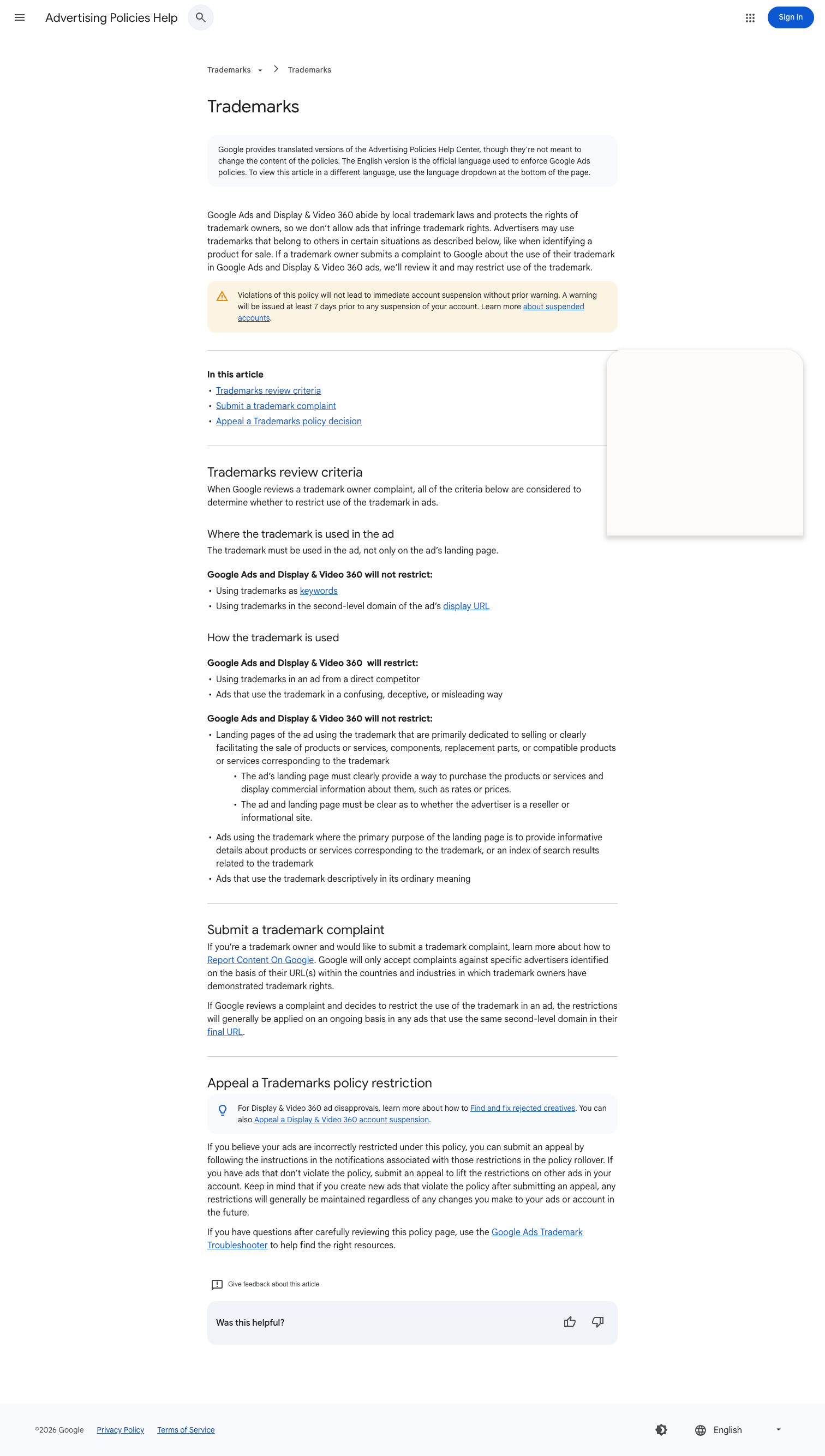
What does Google Ads' trademark policy actually say?
Two sentences from the official policy page do most of the work:
We don't investigate the use of trademarks as keywords. However, we do investigate the use of trademarks in ad text when the trademark owner files a complaint.
That's it. That's the whole framework. Keywords are unrestricted; ad copy is complaint-driven. Google does not patrol for trademark mentions on its own. A rights holder has to file a formal complaint through the Trademark Troubleshooter, name the advertisers they want to restrict, and Google then enforces against those specific accounts. Advertisers who were never named can keep running the exact same copy on the exact same terms.
This is the piece that SMB advertisers miss most often. The policy is not "you can't use trademarks in copy". The policy is "you can't use trademarks in copy once a complaint has named you". We've seen accounts run "Better than [Competitor]" headlines for fourteen months before anyone complained. We've also seen accounts get disapprovals within four hours of a complaint being filed. There is no warning lane.
What changed in 2025-2026?
A few things, and they matter.
February 2025 — complaint-specific enforcement went fully live. The old behavior was that a trademark complaint could knock a term out for a whole category. Now a complaint restricts only the advertisers Google believes were named in the complaint. If you are not on the list, the policy action does not touch you. Search Engine Land covered the transition in detail and the practical effect is that competitor-keyword strategy has gotten more granular — your neighbor getting slapped does not slap you.
Third-Party Authorization Request (TPA) form retired. The old workflow where a trademark owner could hand out "authorization" to specific resellers via a TPA form is gone. Google now relies on the reseller exception, the informational-use exception, and the component-compatibility exception directly. If you used to operate under a TPA, you need to re-examine whether the underlying exception still covers you. It usually does, but re-paper the position.
June 2025 third-party policy tightening. Google quietly tightened the rules for affiliates and lead-gen operators who use brand terms in their copy to route traffic to third-party landing pages. The short version: if your landing page is not the brand's site and not yours with your own comparison content, you are at higher risk of an affiliate-enforcement action, not just a trademark one.
Performance Max and auto-assets. Performance Max campaigns combined with auto-generated assets will happily insert competitor trademarks into your headlines if they appear in your feed or landing page. We've audited dozens of accounts where the advertiser had no idea their PMax creative was generating "HubSpot alternative" headlines on the fly. If you run PMax on brand-adjacent keywords, turn off auto-assets or explicitly exclude competitor terms from the asset library. The headlines Google generates are the headlines Google enforces on.
How much more does it cost?
More than you think.
Quality Score on competitor-brand keywords is almost always lower than on your own brand terms. Google scores relevance by comparing the keyword, the ad copy, and the landing page. When your keyword is "hubspot pricing" and your ad copy and landing page never mention HubSpot — because they legally can't — the relevance signal craters. Lower Quality Score means higher CPC.
In the accounts we've audited across the last twelve months, advertisers report paying roughly 2× to 5× their own-brand CPC on competitor brand keywords. A B2B SaaS client whose own-brand keywords cost $3.80 CPC paid $14–$19 CPC on their biggest rival's name. A DTC eyewear brand bidding on a larger incumbent saw CPCs jump from $1.10 on their own name to $4.60 on the competitor.
Conversion rate is also lower, by two effects stacked. First, competitor-keyword clicks are colder — the searcher wanted the other brand, not you. Second, your landing page cannot mention the brand they searched for, which hurts the scent trail. We've tested exact-match competitor-keyword campaigns against own-brand campaigns for the same advertiser and seen conversion rates 30–60% lower on the competitor side, even with a dedicated comparison page.
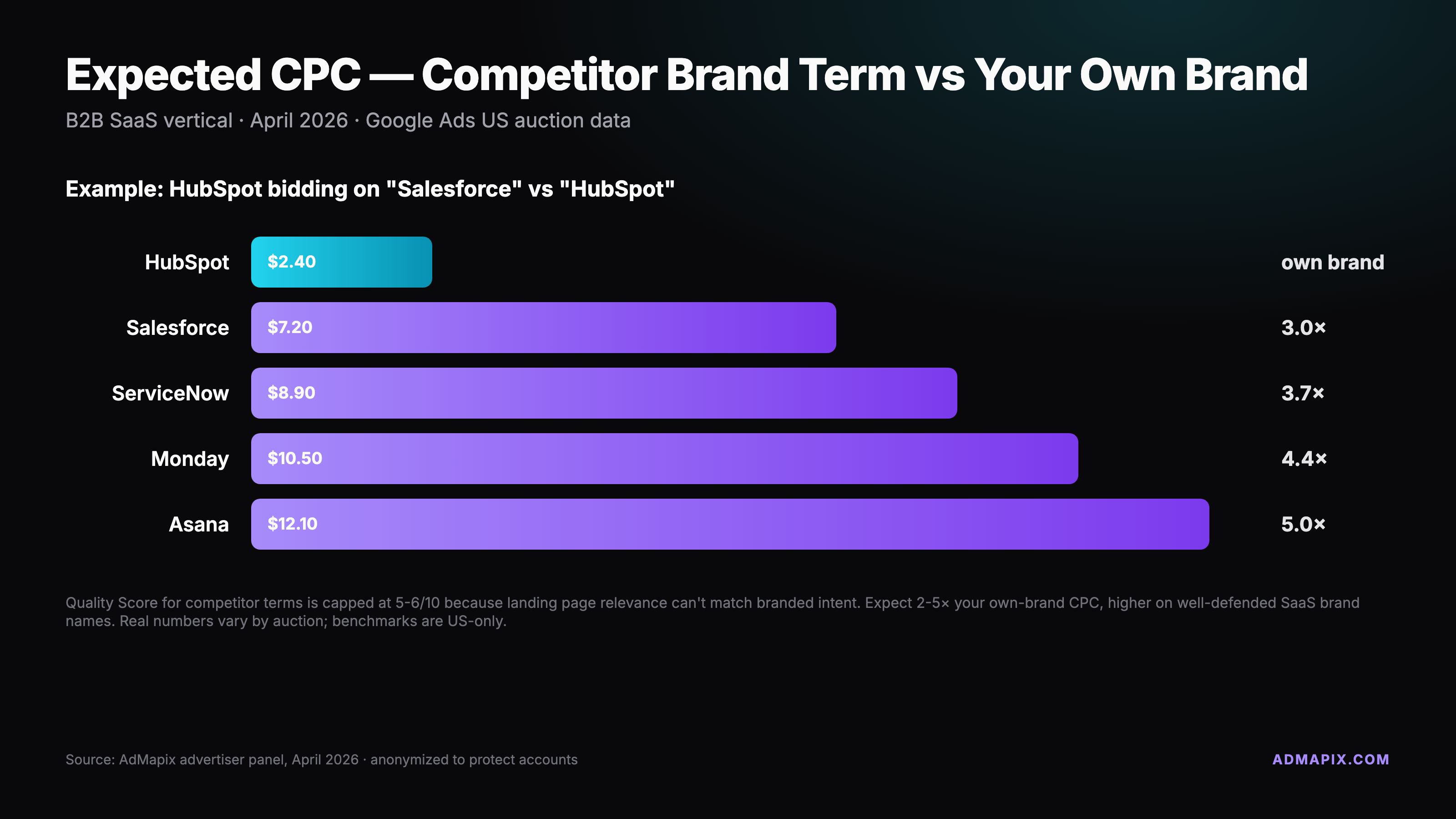
The math still pencils out for a lot of advertisers. If your customer LTV is high enough (most B2B SaaS, most DTC brands with repeat purchase), paying 3× CPC to steal a competitor's bottom-funnel intent click is often profitable. Our own testing across internal campaigns and the SpyFu alternatives we reviewed last week shows that competitor-keyword ROAS lives and dies on landing-page quality, not on keyword bid.
Here's the simple economic test before you launch. Take your allowable CAC (lifetime value × target margin), divide by your expected conversion rate on competitor traffic (assume it's 30–60% lower than your own-brand rate), and that's the max CPC you can afford. If the competitor keyword's actual CPC sits below that ceiling, it's a green light; if it's above, the click is too expensive to convert profitably no matter how good your comparison page is. Run this per competitor keyword, not as a blanket decision — bidding on a rival's high-intent "[brand] pricing" query often pencils out while bidding on their bare brand name (more navigational, colder) often doesn't. The keyword tier matters as much as the brand.
A useful frame: competitor-keyword bidding is conquesting, and conquesting is a margin trade. You're buying a high-intent click that was never going to be cheap, betting your comparison page can convert a searcher who started out wanting someone else. The advertisers who win this consistently are the ones with (a) genuinely differentiated products, (b) high LTV that absorbs the CPC premium, and (c) comparison pages good enough to flip intent. Miss any of the three and conquesting quietly drains budget.
Step-by-step: building a compliant competitor-keyword campaign
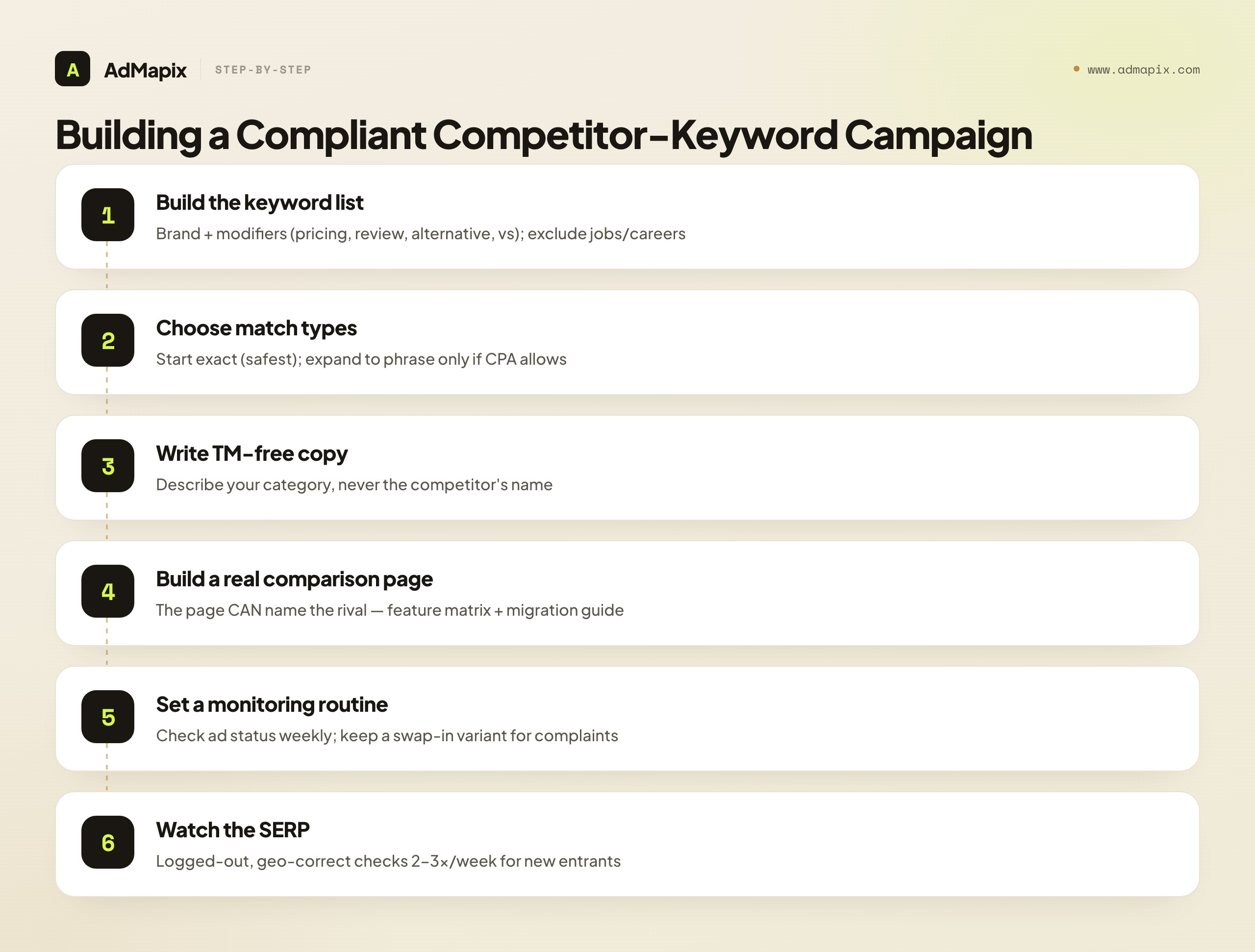
Here is the sequence we use internally when setting up a new competitor-brand campaign for a client.
Step 1: Build a competitor keyword list. Start with the competitor's brand name, then add modifiers: "pricing", "review", "alternative", "vs", "login", "demo", "download". Exclude their own employees and job-related terms ("careers", "jobs", "salary"). Tools like Semrush or AdMapix's own competitor discovery help you find the long-tail query variants that rivals actually get clicks on.
Step 2: Choose match types carefully. Exact match is safest. Phrase and broad match tend to capture navigational queries (people searching for "contact hubspot support") that convert terribly and can upset a legal team watching its own brand SERPs. Start exact, expand later only if CPA allows.
Step 3: Write ad copy with zero trademark mentions. Default copy should describe your product category, not the competitor. Good: "CRM with built-in calling" → "Try it free — 14 days". Bad: "Better than HubSpot". You can name the category ("CRM alternative", "project management tool") without naming a brand. We keep a spreadsheet of three approved ad variants per campaign so when a complaint lands we can swap instantly.
Step 4: Build a real comparison landing page. The landing page can and should mention the competitor by name — the trademark-in-copy rule applies to ads, not to websites. A proper comparison page with a feature matrix, migration guide, and pricing parallel is the single biggest conversion lift in competitor-keyword campaigns. Make sure the URL is not deceptive: yourbrand.com/compare/competitor is fine; hubspot-alternative.com belonging to you is a lawsuit waiting to happen.
Step 5: Set up a monitoring routine. Check the "Ad status" column weekly. If Google disapproves an ad for trademark reasons, the disapproval email will usually name the complainant. Have your swap-in, TM-free variant ready. Do not appeal; just swap. Appeals rarely succeed when a rights-holder complaint is on file and they burn review-team goodwill for future campaigns.
Step 6: Monitor the competitor's SERP. Use Google's own search preview tool (logged out, incognito, correct geo) two or three times a week. You want to know (a) whether your ad is showing, (b) whether the competitor is now bidding defensively on your brand in retaliation, and (c) whether any new player has entered the auction.
The Conquesting Playbook: How to Ethically Bid on Competitor Terms
The setup above gets a campaign live; this section is the craft that makes it convert without crossing the trademark line. "Conquesting" — bidding on a rival's terms to intercept their demand — is a legitimate, widely-used tactic, but the difference between a profitable conquest lane and a disapproved account comes down to three disciplines: copy that never touches the mark, a landing page that does the persuading, and bid/budget settings that respect the cold-traffic reality.
Writing ad copy that converts without the trademark. The hardest constraint in conquesting is that your most persuasive word — the competitor's name — is off limits in the ad. The workaround isn't to get cute with misspellings or spacing (Google reads those as the mark too); it's to out-angle the searcher's intent. Someone searching "[rival] pricing" is price-shopping and comparison-minded, so lead with the dimension where you win: "Transparent pricing, no per-seat tax" beats a vague "The better CRM." Someone searching "[rival] alternative" has already decided to leave, so your copy should reduce switching anxiety: "One-click migration · keep your data · 14-day free trial." Name the category freely ("project management tool," "CRM alternative") and the benefit sharply; just never name the brand. Keep three approved, trademark-free variants per ad group on hand so a complaint-day swap is instant rather than a scramble.
Make the landing page carry the comparison. This is the lever almost everyone under-uses. The trademark-in-copy rule stops at the ad — your landing page can and should name the competitor directly. A real /compare/[rival] page with an honest side-by-side feature matrix, a migration guide, a pricing parallel, and a clear "why teams switch" section is the single biggest conversion driver in any conquest campaign, because it gives the cold, skeptical searcher exactly the comparison they came looking for. The ad earns the click on a neutral angle; the page wins the decision with the named comparison. Keep the matrix scrupulously truthful — overstated comparative claims invite both a trademark complaint and, in stricter jurisdictions, a false-advertising one.
Bid and budget for cold traffic. Conquest clicks are colder and pricier than your own-brand clicks, so the settings that work for brand defense will bleed money here. Start exact match only — phrase and broad match drag in navigational queries ("[rival] login," "[rival] support") that convert near zero and irritate the rights holder watching their own SERP. Set a separate, capped budget so a conquest experiment can't cannibalize your high-ROAS brand campaign. Use a conservative tCPA or manual-CPC ceiling derived from the allowable-CAC math earlier in this guide, and bid the high-intent modifiers ("[rival] pricing," "[rival] vs") harder than the bare navigational brand term, which rarely pays back. Review search terms weekly and negative out the junk the moment it appears.
Stay inside the ethical and compliance boundary. Ethical conquesting means competing on genuine merit, not deceiving the searcher about who you are. Never imply affiliation, never use "official," never lift the rival's logo into your assets, and make sure a reasonable user always knows the ad and page are yours. That boundary isn't just etiquette — in the EU and UK it's the legal line (the Interflora test turns on whether the user is confused about the advertiser's identity), and even in the permissive US it's what keeps a complaint from escalating into a Lanham Act claim. Conquesting done with clear identity and honest comparison is durable; conquesting that flirts with confusion is a disapproval, or a lawsuit, waiting to happen.
How to Detect When Competitors Are Bidding on Your Brand
Before you defend, you need to know who is actually in your brand auction — and the honest answer is that you can never see a competitor's keyword list directly. What you can do is triangulate from public SERPs, your own account data, and the Transparency Center into a high-confidence read. Detection should be repeatable, not a one-off panic screenshot.
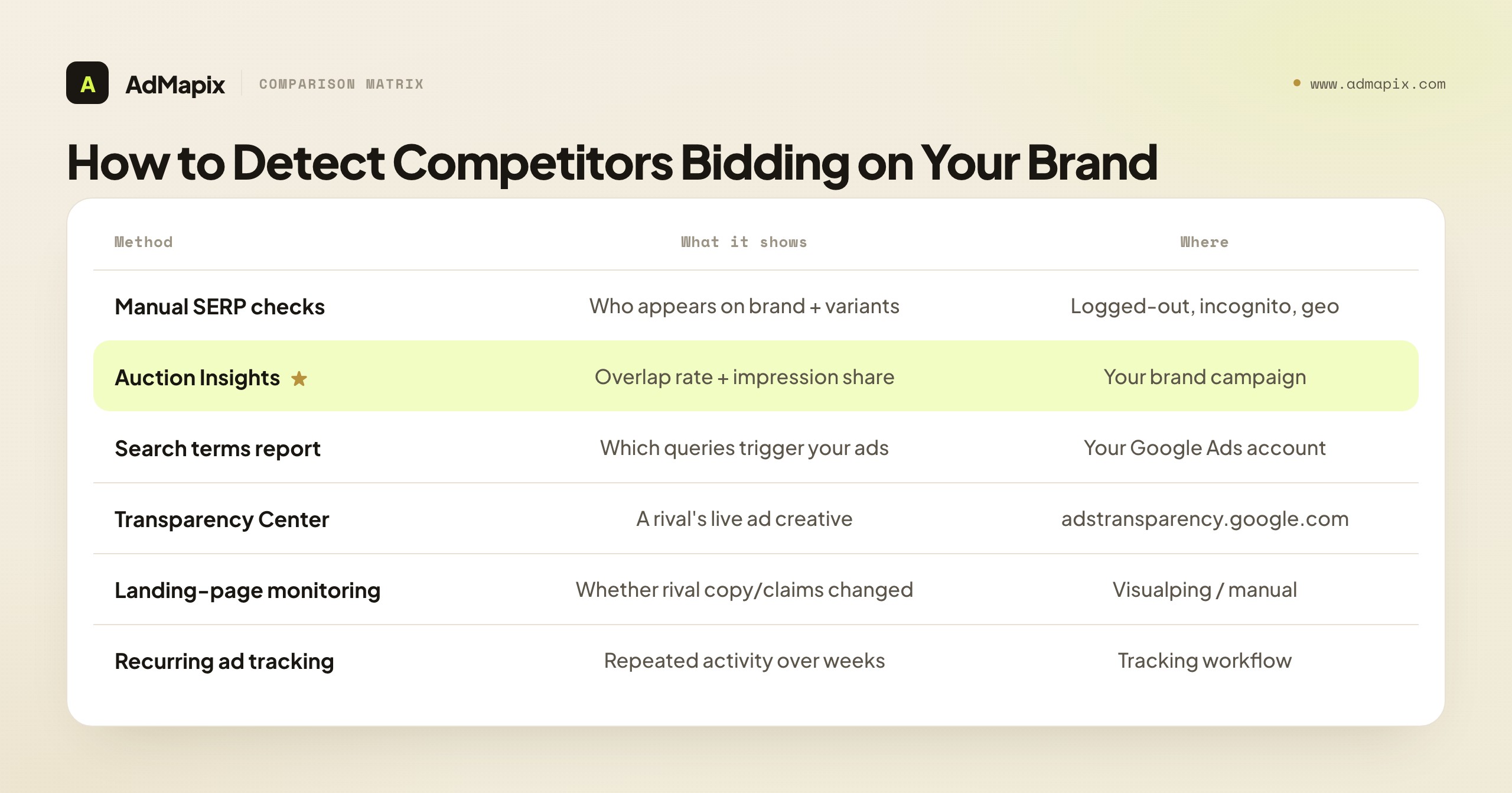
| Detection method | What it shows | Where |
|---|---|---|
| Manual SERP checks | Who appears on brand, brand + pricing, brand + alternative, and misspelling queries | Logged-out, incognito, correct geo |
| Auction Insights | Overlap rate and impression share against other advertisers on your terms | Your Google Ads account, brand campaign |
| Search terms report | Whether competitor-adjacent queries are triggering your own ads | Your Google Ads account |
| Google Ads Transparency Center | Public examples of a specific advertiser's live ads | adstransparency.google.com |
| Landing-page monitoring | Whether a competitor's comparison copy and claims changed | Visualping / manual review |
| Recurring ad tracking | Repeated activity across weeks, not one screenshot | Tracking workflow / tools |
Two of these deserve a deeper look because they're the backbone of brand-bidding detection: Auction Insights and the Transparency Center. They answer different questions, and using them together is far stronger than either alone.
Auction Insights: Who's In Your Auction (and How Often)
Auction Insights is the single most useful brand-defense report, and it lives inside your own account — no third-party tool required. Run it on your brand campaign specifically (not your whole account, which blends in non-brand auctions) and it shows you, for the advertisers competing on your brand terms:
- Impression share — what % of available brand-query impressions you captured versus how much each rival captured.
- Overlap rate — how often a competitor's ad appeared in the same auction as yours.
- Position above rate — how often a competitor outranked you when you both showed.
- Top-of-page rate — how often each advertiser hit the top ad slots.
The critical read: a competitor with a rising overlap rate on your brand campaign is brand bidding on you, and a falling brand impression share on your side means they're stealing visibility you used to own for free. Per Google's Auction Insights help, this doesn't reveal exact competitor spend or bids — but for detection, you don't need spend; you need to know who's there and whether their presence is growing. For a focused comparison of when to reach for this report versus the public Transparency Center, see our Auction Insights vs Transparency Center guide.
Transparency Center: Confirm What a Rival Is Actually Running
The Google Ads Transparency Center is the public-side complement. Where Auction Insights tells you who's in your auction, the Transparency Center lets you pull up a specific advertiser and see the actual ads they're running — useful for confirming whether a rival who shows up in Auction Insights is running brand-conquest copy (and whether that copy crosses the trademark line into your name). Combine the two: Auction Insights flags the intruder, the Transparency Center shows you their creative, and a manual SERP check confirms it's live on your brand query. That three-source triangulation is what turns "I think someone's bidding on us" into a documented, defensible read. Our how to check competitors' Google Ads playbook walks the full free-plus-paid detection stack.
Build an Evidence File Before You Respond
Detection without documentation is rumor. Before you escalate anything — a defensive campaign change, a trademark complaint, a legal conversation — capture a calm, factual evidence file for each intrusion.
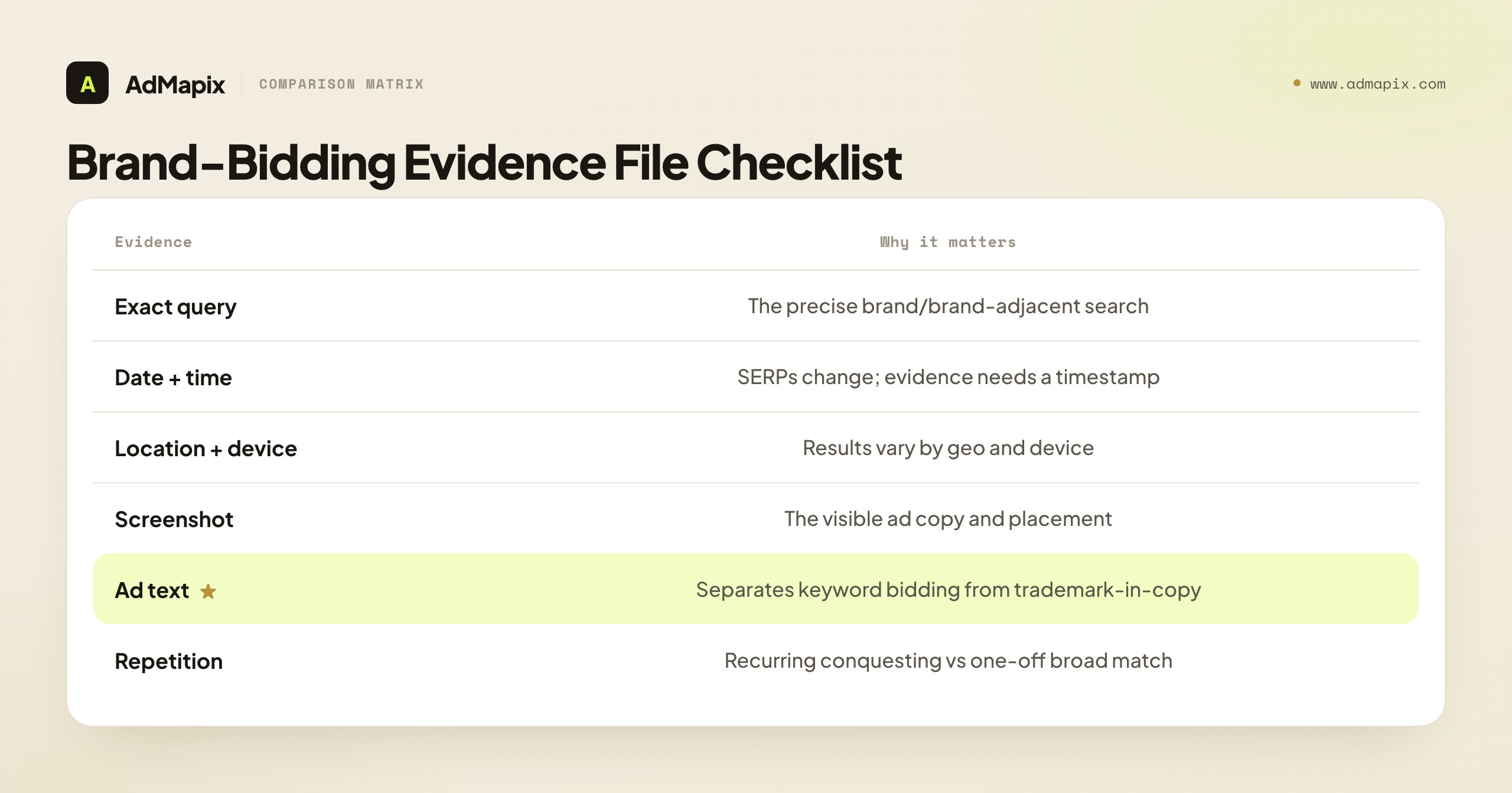
| Evidence to capture | Why it matters |
|---|---|
| Exact query | Shows the precise brand or brand-adjacent search triggered |
| Date and time | SERPs change constantly; evidence needs a timestamp |
| Location and device | Results vary by geography and device |
| Screenshot | Shows the visible ad copy and placement |
| Landing-page URL | Shows where the ad sends users |
| Ad text | Separates keyword bidding (legal) from trademark in copy (actionable) |
| Repetition | Distinguishes recurring conquesting from a one-off broad-match fluke |
| Cost impact | CPC change, impression-share loss, conversion-rate signals |
Keep the file factual. Avoid labels like "illegal" unless counsel has reviewed it — the distinction between a competitor bidding on your keyword (almost always fine) and a competitor putting your trademark in their copy (potentially actionable) is exactly what this evidence file exists to establish. Don't draw legal conclusions from a single screenshot.
Intruder Impression Share: The Metric to Watch
The number that best summarizes brand-bidding pressure is your brand impression share — and its inverse, the share competitors are taking from you. If your brand campaign's impression share is dropping while your bids and budget are unchanged, intruders are eating it.
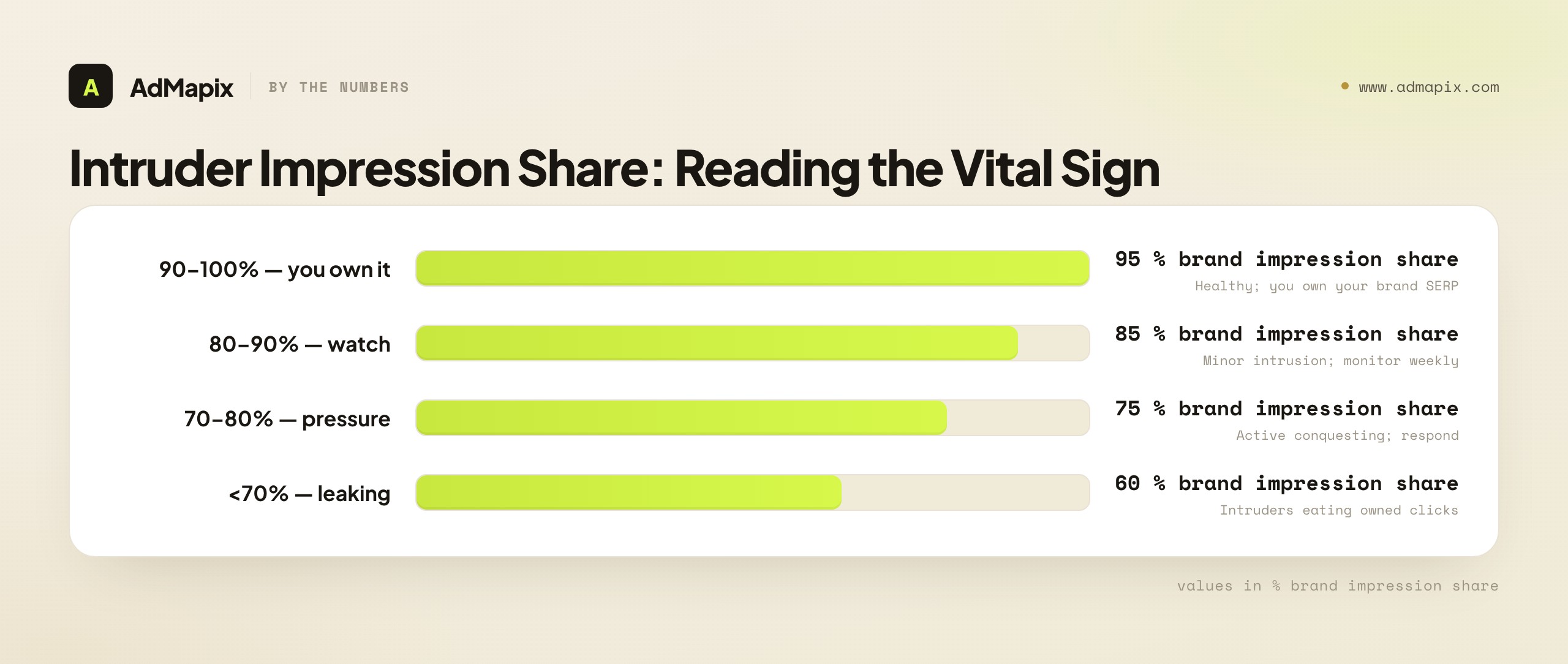
Track it like a vital sign: a stable 90%+ brand impression share means you own your brand SERP; a slide toward 70% or below means competitors are siphoning clicks you should be getting for cents. The tell that it's deliberate conquesting (not just broad-match noise) is correlation — your impression share drops in the same week a specific rival's overlap rate rises in Auction Insights and their conquest ad appears in the Transparency Center. When all three move together, you have a brand-bidding intrusion worth responding to. When only one moves, it may be noise — which is exactly why you triangulate before you act.
How do I fight back when competitors bid on my brand?
Assume they will. This is table stakes.
Defend with a brand campaign first. Run an always-on exact-match brand campaign with high bids and tight ad copy. Your own Quality Score on your own brand name is effectively perfect, so CPCs stay low — usually single-digit cents. The campaign exists to occupy the top ad slot above any competitor bids. Without this, you are paying for organic traffic you already own.
File a Google Ads trademark complaint when copy crosses the line. Keyword bidding on your brand name is legal and filing a complaint about it will not help — Google will not act. What you can act on is ad copy that uses your trademark. Go to the Trademark Troubleshooter, prove you own the registered mark, and name the advertisers. Google typically enforces within 3–5 business days.
Document everything. Screenshot the offending ad, the URL, the date, the geo. If the competitor ignores the complaint and keeps using your trademark in copy, you have evidence for a cease-and-desist letter or a Lanham Act claim.
Consider retaliation, carefully. If a competitor is bidding on your brand, bidding on theirs can restore the auction balance — but it also escalates costs for both sides. Some markets have reached informal detente (the "we don't bid on yours, you don't bid on ours" handshake). HubSpot and Salesforce famously do bid on each other. Monday.com and Asana also trade blows. If your market has a quiet détente, breaking it starts a bidding war that makes Google the only winner.
The Brand-Defense Setup Checklist
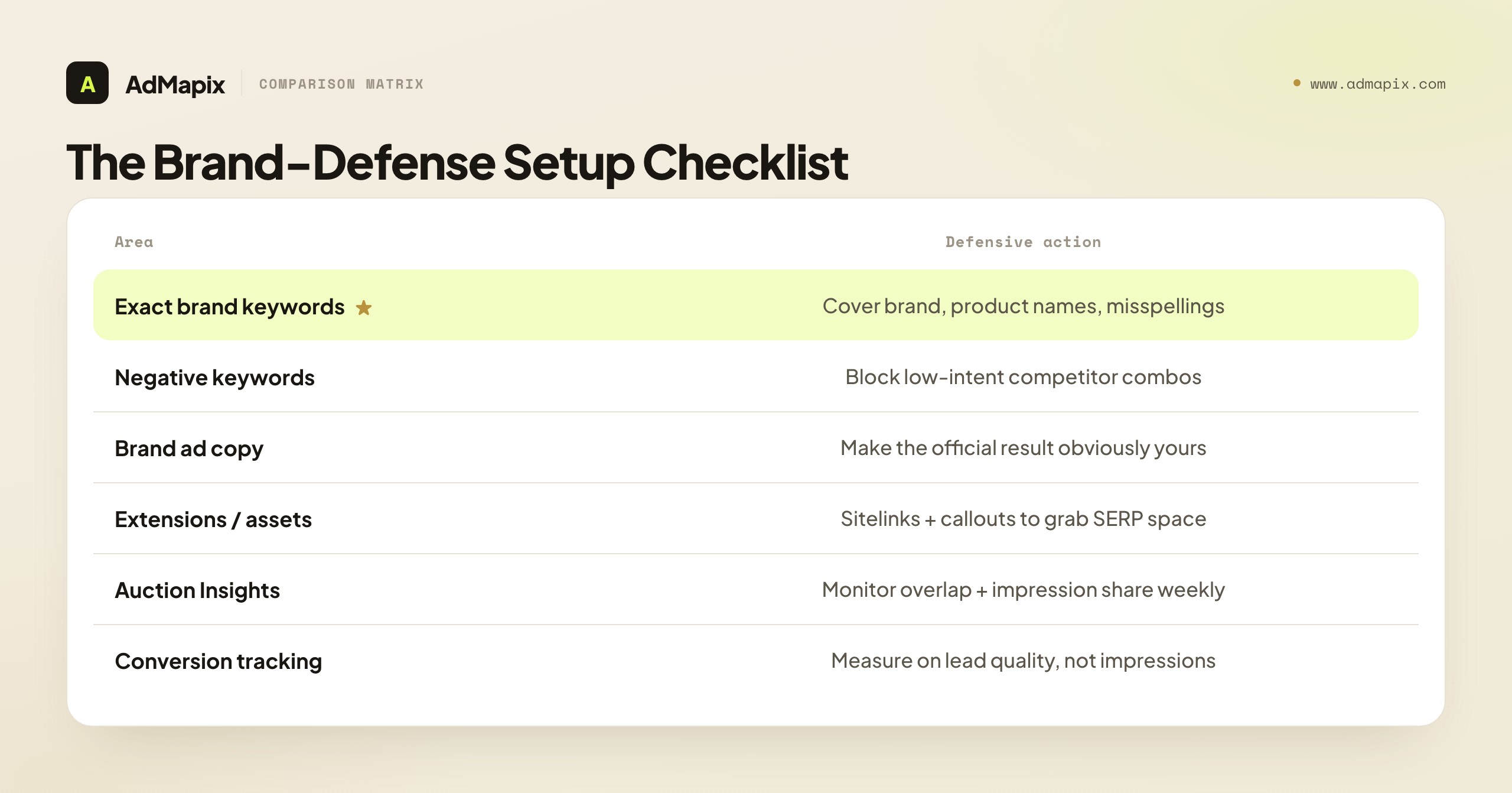
Defending well isn't one action — it's a settings, copy, page, and monitoring stack working together. Audit each:
| Area | Defensive action |
|---|---|
| Exact brand keywords | Cover core brand terms, product names, and common misspellings |
| Match types | Separate exact brand terms from broader brand-adjacent discovery |
| Negative keywords | Prevent low-intent or irrelevant competitor combinations from wasting budget |
| Brand ad copy | Make the official result obviously yours, without unsupported claims |
| Landing page | Send brand searches to a page that confirms trust, proof, and the next step |
| Extensions / assets | Use sitelinks, callouts, structured snippets, and proof to occupy more SERP space |
| Auction Insights | Monitor overlap, impression share, and top-of-page changes weekly |
| Conversion tracking | Measure brand campaigns on lead quality, not impressions alone |
The point of the asset stack (sitelinks, callouts, structured snippets) is real estate: the more vertical space your brand ad occupies, the less room an intruder's ad has above the fold. A bare one-line brand ad invites a competitor to sit right beneath it; a fully-built-out brand ad with four sitelinks pushes them down the page. Defense is partly a land-grab.
Should You Bid on the Competitor's Brand in Return?
Retaliation feels satisfying, but it's a business decision, not an emotional one. Run it through this gate before you escalate:
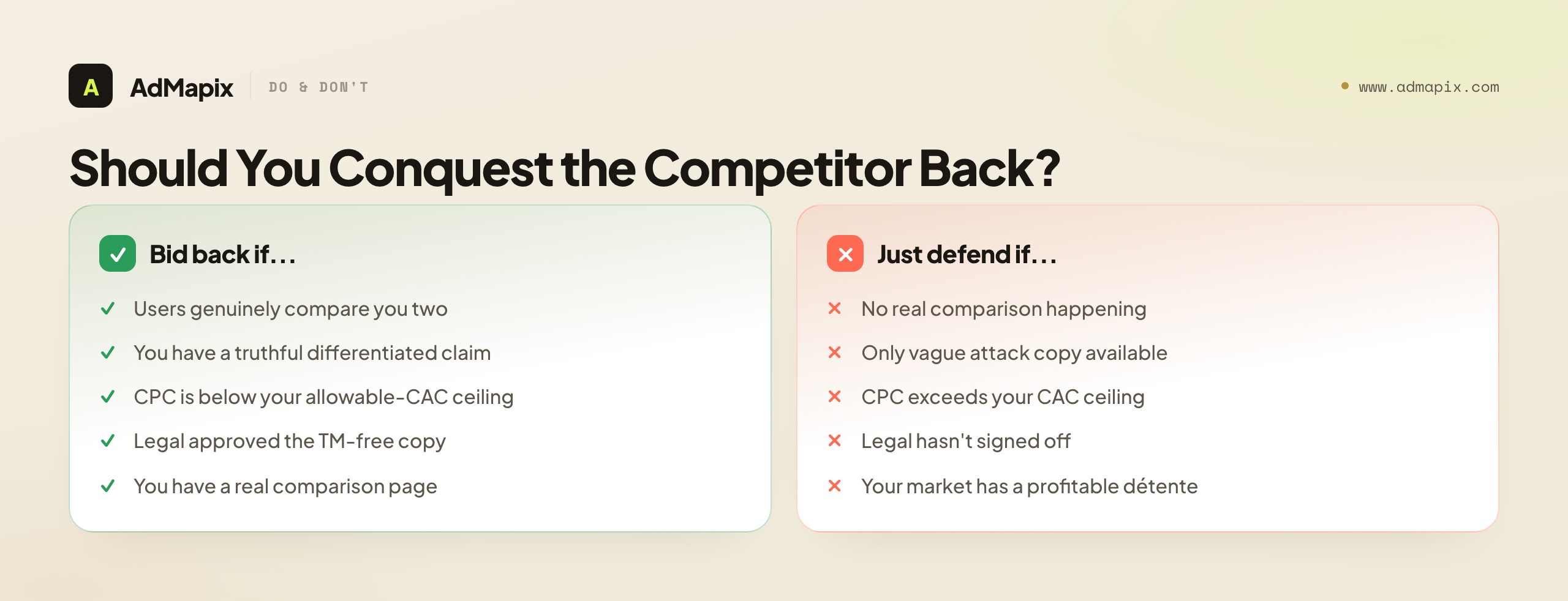
| Question | If yes | If no |
|---|---|---|
| Do users genuinely compare you with this competitor? | A comparison landing page can convert their intent | Generic conquesting will convert poorly |
| Can you make a truthful, differentiated claim? | Test it with real proof | Don't run vague attack copy |
| Is the CPC below your allowable-CAC ceiling? | Set strict budget + conversion thresholds | Monitor instead of bidding |
| Has legal approved the language and approach? | Document the approved copy | Do not proceed |
| Do you have a real comparison/alternatives page? | Point the campaign at it | Build the page before spending a cent |
Competitor bidding isn't automatically smart just because a rival is doing it to you. If your market has a quiet détente and you'd both profit from keeping it, the highest-EV move is often a strong defense (own your brand SERP cheaply) rather than opening a two-front war that only Google profits from.
The Monitoring Cadence
Brand-bidding pressure spikes around launches, funding announcements, seasonal promotions, review-site campaigns, and category news — so monitoring has to be rhythmic, not reactive.
| Cadence | Task |
|---|---|
| Daily (during an incident) | Check priority brand queries; capture new intrusions or copy changes |
| Weekly (normal) | Review SERP captures, Auction Insights overlap + impression share, CPC, conversion quality |
| Monthly | Update negatives, refresh the comparison page, update the evidence folder and competitor watchlist |
| Quarterly | Reassess whether each intruder warrants a response or just continued monitoring |
For recurring monitoring without rebuilding the process by hand, our Google Ads competitor analysis guide systematizes it, and AdMapix reports turn recurring competitor-ad evidence into a shareable artifact. The deeper the automation, the more likely the cadence actually survives a busy quarter.
The Escalation Path: When a Competitor Crosses the Line
Most brand-bidding intrusions never need to escalate beyond a stronger defensive campaign — a rival bidding on your keyword with neutral copy is playing the same legal game you do. Escalation is for the narrower case where a competitor puts your trademark in their ad copy, implies affiliation, or runs deceptive comparison claims. When that happens, walk the ladder deliberately; jumping straight to lawyers is expensive and usually unnecessary.
Rung 1 — Document and classify. Before anything, complete the evidence file (query, timestamp, geo, screenshot, landing-page URL, exact ad text). The decisive question is whether your trademark appears in the visible ad text or display URL (actionable) or merely as a keyword trigger (almost never actionable). If it's only a keyword trigger, stop here — filing a complaint about keyword use will go nowhere, and you're better served by the defensive playbook above.
Rung 2 — File a Google Ads trademark complaint. If your mark is in their copy, go to Google's Trademark Troubleshooter, verify ownership of the registered mark, and name the specific advertisers. Since the February 2025 move to advertiser-specific enforcement, your complaint restricts only the advertisers you name — so name them precisely. Google typically actions valid complaints within 3–5 business days, disapproving the offending ads. This rung resolves the large majority of legitimate trademark-in-copy cases without a lawyer ever getting involved, and it costs nothing but the time to file.
Rung 3 — Send a cease-and-desist. If the competitor keeps using your mark in copy after Google enforcement — for instance, by spinning up new ad variants or a new account — a formal cease-and-desist letter from counsel is the next step. The right moment is after you've documented repeated, deliberate post-enforcement violations: a single disapproved ad that they let die doesn't warrant a C&D, but a pattern of re-uploading trademarked copy does. The letter signals you're tracking the behavior and prepared to litigate, which resolves many cases on its own because the cost-benefit no longer favors the infringer.
Rung 4 — Legal action. Escalate to a Lanham Act claim (or the equivalent in your jurisdiction) only when there's persistent, willful trademark use in copy and a plausible likelihood-of-confusion argument — and remember the Warby Parker line of cases makes keyword-only use a weak basis for a suit in the US. This rung is reserved for genuine brand impersonation or sustained deceptive copy, not for ordinary competitive bidding. Loop in counsel early to assess whether your facts clear the confusion bar before you spend on litigation; in many keyword-only situations, they won't, and the smarter spend is on a better defense and comparison page.
The throughline: match the response to the violation. Keyword bidding gets a defensive campaign, not a lawyer. Trademark-in-copy gets a Google complaint first, a C&D on repeat, and litigation only for willful, confusing impersonation. Escalating proportionally keeps your legal spend rational and your evidence clean if you ever do need to litigate.
International: what's different in the EU, UK, and Australia?
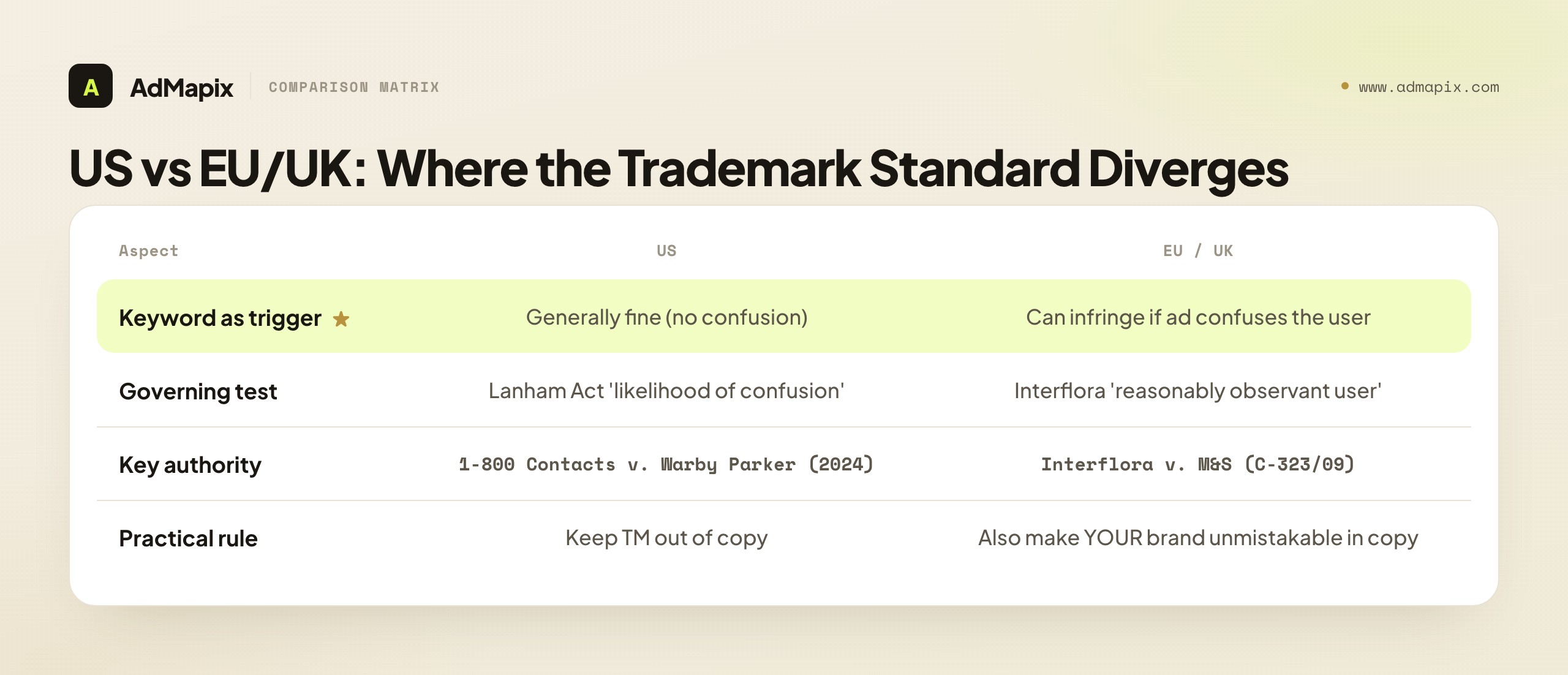
Jurisdiction matters more than most US advertisers realize.
European Union and EFTA states (including Switzerland and Norway): Stricter. The CJEU's ruling in Interflora v. Marks & Spencer (C-323/09) established that even keyword use can infringe a trademark where the ad does not make clear to a "reasonably well-informed and reasonably observant" internet user that the advertiser is a third party unconnected to the trademark owner. Practical effect: in the EU, sloppy ad copy that leaves the user confused about who the advertiser is can lose a trademark case even where US courts would have sided with the advertiser.
United Kingdom: Post-Brexit the UK retains the Interflora test via retained EU case law. Same practical standard as the EU.
Australia: The ACCC and the Trade Marks Act 1995 create a trademark framework closer to the US, but Australian Consumer Law adds a "misleading or deceptive conduct" prong that has been used against advertisers whose copy implies affiliation. Safer to stay on the conservative side and follow US-style "no trademark in copy" rules.
Canada: The Trade-marks Act plus provincial consumer-protection laws. Canadian courts have generally followed US reasoning on keyword-only use.
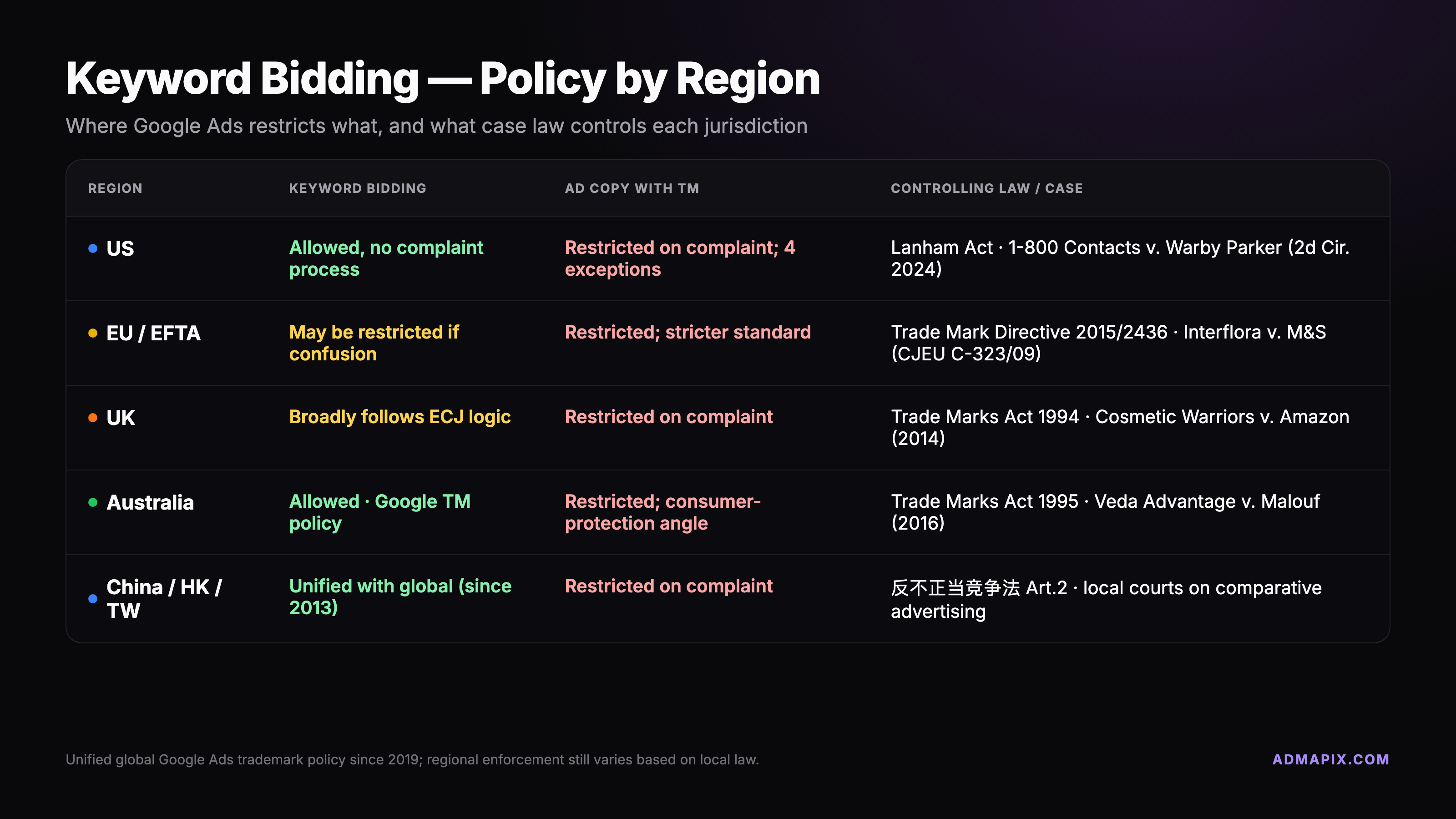
If you run campaigns in multiple regions, geo-segment them. A compliant US ad may be an infringing EU ad. The easiest rule of thumb: in the EU and UK, make sure the ad copy itself unambiguously identifies your brand — logos, name in the headline, clear call-to-action that mentions your company — so no reasonable user could think your ad came from the competitor.
Real examples
HubSpot vs Salesforce. Both run aggressive competitor-keyword campaigns on each other. HubSpot lands cold clicks on a /compare/salesforce page with a feature matrix and migration content. Salesforce does something similar. Neither uses the other's name in ad copy. Both accept the 3× CPC premium because the CRM category LTV supports it.
Monday.com vs Asana. Similar shape. We've seen Monday.com run headlines like "Work OS that just works" on Asana-branded searches, with a comparison landing page that mentions Asana by name. Asana's defense is a heavier always-on brand campaign and faster trademark-complaint filing.
Zenni Optical vs Warby Parker. Relevant to the 2024 Warby Parker ruling. Zenni and EyeBuyDirect both bid on Warby-related terms. After the Second Circuit decision, Warby's legal leverage in this space narrowed — the ruling effectively greenlit competitor keyword bidding in eyewear as long as ad copy stays neutral.
Zappos on Nike (reseller exception). Classic example of the reseller path. Zappos sells Nike products, Nike is a primary product on Zappos' landing pages, so Zappos can and does run ads naming Nike in the copy. Nike has not filed against Zappos because the reseller relationship is legitimate. Pure affiliates running "Nike shoes cheap" headlines would not qualify.
A Worked Example: Detecting, Defending, and Conquesting
To tie offense and defense together, here's a composite walkthrough (anonymized from 2026 B2B SaaS accounts) showing the full loop on one mid-market project-management tool we'll call "Flowly."
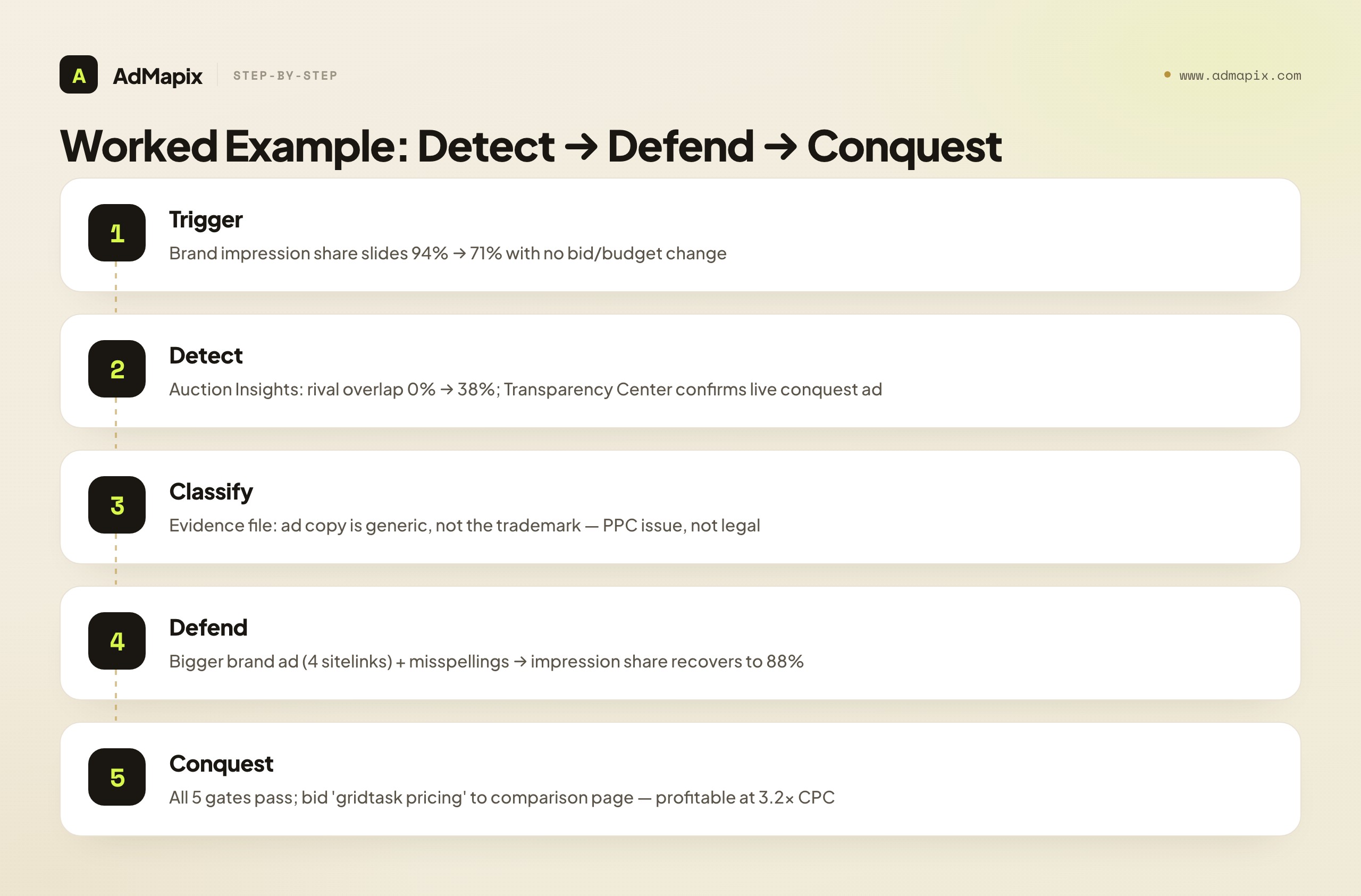
The trigger (detection). Flowly's brand campaign impression share slid from 94% to 71% over three weeks with no change to their bids or budget. That drop was the alarm. Running Auction Insights on the brand campaign specifically showed a rival — call it "GridTask" — with an overlap rate that had climbed from near-zero to 38%, and a position-above rate that meant GridTask was frequently outranking Flowly on Flowly's own name. The Transparency Center confirmed GridTask was running a live "Switch from clunky PM tools" ad. A logged-out, geo-correct SERP check confirmed it was appearing on the literal query "flowly."
The evidence file. Flowly captured the query, timestamp, geo, screenshot, GridTask's landing-page URL, and the exact ad text. Critically, the ad copy did not use the word "Flowly" — it used the generic "clunky PM tools." That single fact set the response: this was a keyword-bidding intrusion (legal, a PPC problem) not a trademark-in-copy intrusion (potentially actionable). No legal escalation warranted — yet.
The defense. Flowly rebuilt its brand ad to occupy more SERP space (four sitelinks, callouts, a structured snippet), tightened exact-match coverage on common misspellings, and raised brand bids modestly. Within two weeks, brand impression share recovered to 88% — they'd re-grabbed the real estate.
The offense decision. Should Flowly conquest GridTask back? Running the gate: users did compare the two, Flowly had a genuine differentiation (better migration tooling), the competitor keyword CPC sat below their allowable-CAC ceiling, legal approved TM-free copy, and they had a real /compare/gridtask page. All five gates passed, so Flowly launched an exact-match campaign on "gridtask" and "gridtask pricing," copy describing the category ("PM tool with one-click migration"), routing to the comparison page.
The outcome. The defense recovered owned traffic immediately. The conquest campaign ran at ~3.2× Flowly's own-brand CPC but converted profitably on the "gridtask pricing" high-intent term (the bare "gridtask" navigational term did not, and was paused). Net: brand SERP re-owned, plus a profitable bottom-funnel conquest lane — discovered through detection, validated through the economic gate, and kept compliant by keeping the trademark out of the copy. The whole loop took about five weeks.
The lesson isn't the specific numbers. It's the sequence: a falling impression share triggered detection, triangulation identified the intruder, the evidence file classified the intrusion correctly (keyword vs copy), defense recovered owned traffic, and only then did a disciplined economic gate green-light a compliant counter-attack.
Frequently asked questions
Can I bid on competitor keywords in Google Ads?
Yes. In the US it's legal to bid on a competitor's keywords — including their brand name — as keyword triggers, because the consumer sees your ad, not your keyword list, and US courts have consistently found that keyword selection alone doesn't create likelihood of confusion. The restriction applies to your ad copy: you can't put the competitor's trademark in your headline, description, or display URL once they file a complaint, unless you qualify for a narrow exception. Keywords are unrestricted; copy is complaint-driven.
Can I use a competitor's brand name in my Google Ads?
In the keyword list, yes. In the visible ad text, generally no — not once the trademark owner files a complaint — unless you fall under the reseller, components/compatible, informational, or descriptive-use exception. Your landing page, however, can name the competitor (the copy rule applies to ads, not websites), which is why a real comparison page is the workhorse of compliant competitor-keyword campaigns.
How do I know if a competitor is bidding on my brand keywords?
Triangulate three sources. Run Auction Insights on your brand campaign to see which advertisers overlap with you and how often (a rising overlap rate is the tell); use the Google Ads Transparency Center to pull up a suspected rival and confirm the ad they're running; and do logged-out, geo-correct manual SERP checks on your brand terms. When a falling brand impression share correlates with a specific rival's rising overlap rate and a live conquest ad in the Transparency Center, you have a confirmed brand-bidding intrusion.
What is intruder impression share and why does it matter?
It's the share of your brand-query impressions that competitors are capturing instead of you. If your brand campaign's impression share is sliding while your bids and budget are unchanged, intruders are eating it. A stable 90%+ means you own your brand SERP; a slide toward 70% or below signals active conquesting. It's the single best vital-sign metric for brand-bidding pressure because it summarizes the whole auction in one number.
How much does bidding on competitor keywords cost?
Expect roughly 2×–5× your own-brand CPC. Quality Score craters on competitor keywords because Google compares your keyword to your ad copy and landing page — and you legally can't mention the brand the searcher typed. Conversion rates also run 30–60% lower since the clicks are colder. It still pencils out when LTV is high and your comparison page is strong; the economic test is whether the competitor CPC sits below your allowable-CAC ceiling, run per keyword (high-intent "[brand] pricing" terms convert far better than bare navigational brand terms).
Can I bid on a competitor's brand in a Performance Max campaign?
Yes — Performance Max respects the same trademark framework. The risk is auto-generated assets pulling competitor names into headlines. Disable auto-assets or exclude trademark terms from your asset library, and audit generated copy weekly. Otherwise Google's automation will write ad copy that gets you disapproved.
What happens if I ignore a trademark complaint email from Google?
Google will typically disapprove the specific ads named in the complaint within a few business days. If you keep editing them to evade enforcement, the account can be flagged for repeated policy violations. The severe outcome is account suspension, which is much harder to undo than just replacing the ad copy.
Is Dynamic Search Ads (DSA) a loophole?
No. DSA can pull competitor trademarks into headlines via page content. Google enforces on DSA the same way it enforces on regular text ads — if a complaint names you, headlines get restricted regardless of whether a human or the algorithm wrote them. Exclude competitor-branded pages from your DSA target.
Can I use the competitor's logo on my landing page?
Probably no. Nominative fair use allows some trademark reference on comparison pages, but logos add a likelihood-of-confusion signal that courts weigh heavily. A typeset brand name in a comparison table is usually safe; a pixel-perfect logo suggests endorsement. Ask a lawyer before shipping a page with a competitor's logo on it.
Does bidding on a competitor's brand hurt my ad account's standing with Google?
No. Google's account-quality signals track policy compliance, payment history, and user experience — not competitive aggression. Competitor-keyword campaigns are routine and widespread. They do not, on their own, affect account reputation as long as you are not violating trademark, impersonation, or misleading-content rules.
Wrapping up
The rules in 2026 are more settled than they have been in a decade. US keyword bidding on competitor trademarks is legal, Google has clarified the complaint-driven enforcement model, and the 2024 Warby Parker ruling gave advertisers fresh case law to rely on. Ad copy is still the line. Put the trademark in your keyword list, keep it out of your headlines, route traffic to a real comparison page, and watch your disapprovals closely — you will be fine in most markets.
If you run campaigns in the EU, the UK, or Australia, tighten the copy standard and identify your brand unambiguously in every ad. If you get complaint email, swap, don't argue. And if you want to see what competitors are actually bidding on before you launch, AdMapix's competitor intelligence tooling and our best-practices guides walk through the discovery and planning stages in more detail.
For the full Google Ads competitive-research workflow that this brand-bidding playbook sits inside — Ad Rank decoding, keyword inference, landing-page intelligence, and confidence scoring — see our AdWords intelligence guide. It's the parent playbook; this page is the deep dive on the brand-bidding slice of it.
Paid search is a game of small moves repeated daily. Competitor-keyword campaigns are one of those moves — not magical, not illegal, just disciplined.
Sources
- Google Ads — Trademarks policy
- Google Ads — Trademark Troubleshooter (complaint form)
- Google Ads — About Auction Insights
- Google Ads Transparency Center
- USPTO — Trademark laws (Lanham Act, 15 U.S.C. §1051 et seq.)
- 1-800 Contacts v. Warby Parker (2d Cir. 2024, full opinion)
- Eric Goldman — analysis of the Warby Parker keyword-advertising ruling
See what competitors are really running
Search 91M+ creative combinations across 170+ market labels. New accounts include 30 lifetime Free credits.
Related Articles
Ad Optimization Best Practices: The 2026 Performance Playbook
The definitive 2026 guide to ad optimization best practices — a high-output creative production system, statistically honest A/B testing, budget governance and pacing rules, the metrics that matter, structured account hygiene, an optimization cadence, and an FAQ that settles the hard questions performance teams keep arguing about.
WhatRunsWhere Alternative in 2026: Legacy Media-Buying Intelligence or Modern Creative Research?
A complete 2026 buyer's guide to choosing a WhatRunsWhere alternative — why teams look past this legacy media-buying tool, what it actually does (display, native, and mobile placements and publisher paths), the three layers of competitive intelligence, the legacy-access risk to check first, how to evaluate alternatives, who should choose which, a migration plan, the honest limits of public ad data, and where a modern cross-network creative tool like AdMapix fits.
Moat Alternative in 2026: Ad Verification vs. Creative Intelligence
A complete 2026 buyer's guide to choosing a Moat alternative — why teams look past Oracle Moat, what Moat actually does (viewability, invalid traffic, brand safety), the critical split between the ad-verification layer and the creative-intelligence layer, a layered comparison across coverage and fit, who should choose which, a practical migration plan, the honest limits of public creative data, and where a creative-research tool like AdMapix fits.